
‘God is good’: Inside the high-risk US mission to save a wounded airman shot down in Iran
In a scene that unfolded like a Hollywood script, hundreds of American troops descended into the rugged mountains of southwestern Iran on Saturday to rescue a wounded airman who spent nearly two days hiding from Iranian forces.
What followed was a high-stakes combat search-and-rescue mission deep inside Iran, with U.S. forces racing to locate and extract the wounded officer before Iranian troops could reach him, deploying a large contingent of special operations forces and aircraft into hostile territory.
CIA Director John Ratcliffe compared the mission to find the downed airmen to finding “a grain of sand in the desert” in a news briefing Monday.
In total, the U.S. sent in more than 150 aircraft, President Donald Trump Monday, which took on “very, very heavy enemy fire” during the rescue operation. Several different teams: Navy SEALs, Air Force Special Operations, Army Special Operations Aviation, search and rescue and combat medics, also took part.
US PILOT RESCUED FROM DOWNED F-15E FIGHTER JET IN IRAN, SEARCH FOR SECOND CREW MEMBER ONGOING
“This was an incredibly dangerous mission, an incredibly dangerous undertaking,” Gen. Dan Caine, chairman of the joint chiefs of staff, said Monday at the White House press briefing.
One of the two crew members was flown to Landstuhl regional medical center in Germany, typically the first stop for U.S. soldiers wounded in combat zones, and the other is being flown there Monday, a senior U.S. defense official told Fox News.
As the rescue unfolded Easter Sunday, the pilot radioed a brief message to help U.S. forces identify him: “God is good,” officials said.
Here’s a look at how the scene unfolded.
Friday — The shoot down and the first rescue
A U.S. F-15E Strike Eagle fighter jet was shot down over Iran Friday, according to U.S. officials. Both the pilot and the weapons systems officer ejected from the aircraft.
The aircraft was operating as part of ongoing U.S. combat operations over Iran when it was shot down.
While details of the incident were not immediately clear, Iranian state media released images of an ejection seat and debris that appeared consistent with an F-15E. Iran initially claimed it had downed a more advanced F-35 stealth fighter, but U.S. officials later confirmed the aircraft was an F-15 Strike Eagle.
The F-15E Strike Eagle is a two-seat fighter jet flown by a pilot and a weapons systems officer, who manages targeting, sensors and weapons. The aircraft is designed for both air-to-air combat and deep strike missions against ground targets, allowing it to operate far inside enemy territory.
After the crew ejected and aircraft went down, rescue beacons went off, which send out a radio or GPS signal, officials said Monday at the press briefing, and U.S. forces quickly launched a combat search-and-rescue mission, deploying rescue helicopters into Iranian territory to recover the downed pilot.
“We flew for seven hours in daylight over Iran to get the first pilot, and we flew seven hours in the middle of the night to get the second,” War Secretary Pete Hegseth said Monday.
The pilot was rescued later that day, within hours of the shoot down, in what Trump described as a daylight operation.
Rescue helicopters, including HH-60W Jolly Green II aircraft, came under Iranian small-arms fire as they moved in to extract the pilot, according to U.S. officials. Crew members aboard the helicopter carrying the pilot were injured, but the aircraft was able to fly safely out of Iranian territory.
An A-10 Thunderbolt II providing close air support for the rescue effort was also hit by enemy fire, according to U.S. officials. The aircraft was damaged, and the pilot later ejected over Kuwaiti airspace and was recovered.
Caine said the A-10s were flying in the “Sandy” role — a mission focused on protecting downed airmen and guiding rescue forces into hostile territory.
“A Sandy has one mission, get to the survivor, bring the rescue force forward and put themselves between that survivor on the ground and the enemy,” Caine said Monday.
“While this was ongoing and out in front of them, the Sandy flight of A-10s and other remotely piloted aircraft, drones and other tactical aircraft were violently suppressing and engaging the enemy in a close-in gunfight to keep the objective area,” he said.
Saturday — The hunt for the weapons system officer (WSO)
While the Pentagon remained tight-lipped about the mission, Iranian state media blasted images from the crash and called on civilians to join in the search for the second crew member, an Air Force colonel, according to Trump.
The Pentagon has not publicly released the names of the crew members, a standard practice while operations are ongoing. Both airmen have been recovered and are receiving medical care at a U.S. military facility, according to officials.
Iranian state media urged civilians to help locate the missing crew member and offered a reward for his capture, while Islamic Revolutionary Guard Corps (IRGC) forces launched a search in the region.
The weapons systems officer, a colonel with SERE training, was using his survival and evasion training to stay one step ahead of Iranian forces. He reportedly climbed 7,000 feet up a ridge and remained hidden there for nearly 48 hours, a senior defense official told Fox News.
“He was injured quite badly,” Trump said during a news briefing Monday. “He scaled cliff faces, bleeding rather profusely, treated his own wounds.”
The colonel hid in a mountain crevice while the CIA launched a deception campaign to convince the Iranian regime they had already located him and were moving him to the ground for exfiltration. While the Iranians were confused and uncertain of what was happening, the agency used its specialized capabilities to locate the American airman, a senior administration official told Fox News.
AIRMAN RESCUE SHOWS U.S. CAN PENETRATE ENEMY TERRITORY ‘ANYWHERE’ IN IRAN, FORMER PENTAGON OFFICIAL WARNS
Trump said the American aviator was being “hunted down” by enemies who were “getting closer and closer by the hour.”
The U.S. used MQ9 Reaper drones to protect the area around where the U.S. believed the airman was hiding and fired on anything that came close to that area and any area where U.S. forces were operating, an administration official told Fox News.
“At the president’s direction, we deployed both human assets and exquisite technologies,” Ratcliffe said, calling it “a daunting challenge, comparable to hunting for a single grain of sand in the middle of a desert.”
At the same time, the U.S. launched strikes on nearby areas to keep Iranian forces away.
“We executed multiple large scale strikes in the surrounding area using every tactical jet in the U.S. inventory + B-1 Bombers to keep him safe,” a senior U.S. official said.
In between the rescue of the pilot and the rescue of the weapons officer, U.S. forces flying B2 bombers from Whiteman Air Force Base in Missouri dropped “bunker buster” massive ordnance penetrator bombs on an IRGC headquarters, a senior defense official told Fox News.
Sunday — The final rescue
At the right moment, Trump said, he directed the military to send dozens of heavily armed aircraft to rescue the crew member, who the president said is “seriously wounded” but will recover.
When the colonel finally made radio contact to coordinate the pickup, he sent the message: “God is good.”
U.S. officials were not sure it was him at first. Trump told Axios they feared it was a trap. But those who knew the colonel said he was a man of deep faith.
Rescue helicopters, including HH-60 Pave Hawk aircraft, came under Iranian small-arms fire during the extraction, sources told Air and Space Forces magazine.
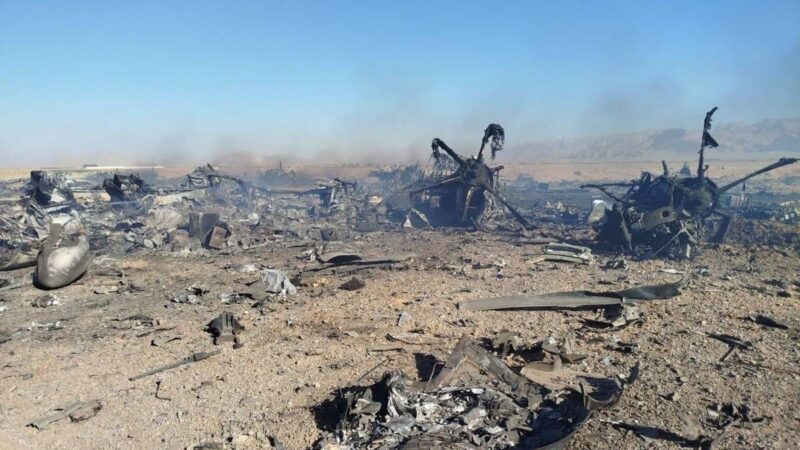
U.S. forces established a remote airstrip inside Iran to support the rescue.
“This was not much of a runway,” Trump said. “This was a farm, not a runway.”
Problems with two other transport planes prompted U.S. forces to blow them up rather than leave them behind in Iran, according to The Associated Press.
“The fact that we were able to pull off both of these operations, without a SINGLE American killed, or even wounded, just proves once again, that we have achieved overwhelming Air Dominance and Superiority over the Iranian skies,” Trump said on social media.
The Associated Press contributed to this report.
<!–>
–>